Tag: Paul

  • Out of Alignment

    Out of Alignment

    The diagnosis of our time, and the cry underneath it


    The Anatomy of Missing the Mark (Hamartia)Three phases on one stage: unity before articulated experience; rupture around 100,000 BCE, when the human race articulates its experience and begins to live in the articulation; and autonomous agency from then until today, acting on the scene from outside it.MODEL 07 · THE ANATOMY OF MISSING THE MARK (HAMARTIA)The birth of autonomous agency1 · UnityBEFORE c. 100,000 BCEExperience is not yet articulated.The human race lives directly inside it.2 · Rupturec. 100,000 BCEThe human race articulates its experience —and now lives in the articulation of the experience.3 · Autonomous agencyc. 100,000 BCE → TODAYIt acts from the articulation, outside the scene.Every attempt lands beside the mark.BEFOREc. 100,000 BCETODAY

    ACT I — THE DIAGNOSIS

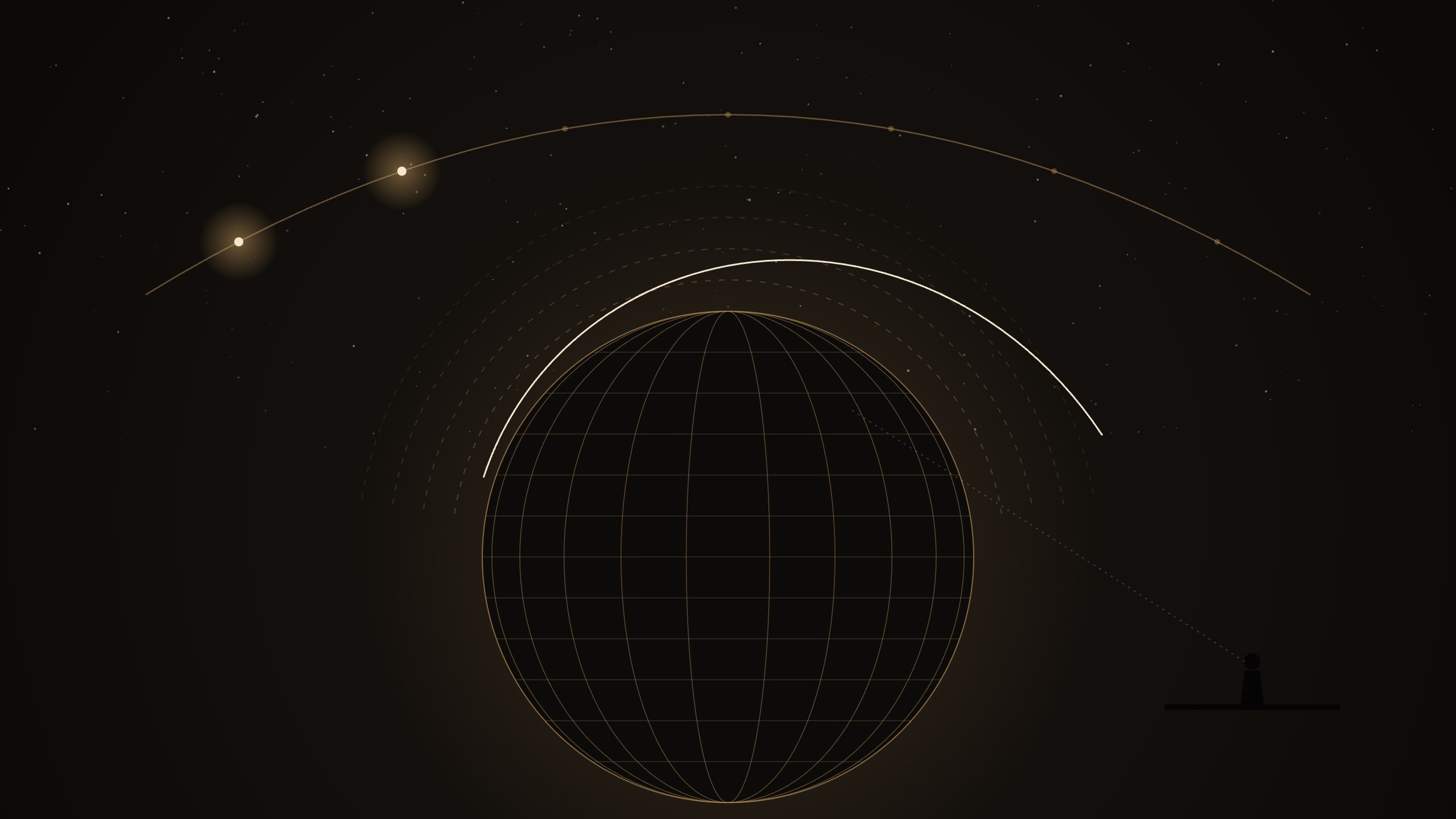
    A gridded planet ringed by dashed boundary lines, a rising curve crossing them, observed by a lone figure on a platform outside, under an arc of seven lights.

    1. The Vocabulary of Missing

    Listen to the words our time uses about itself. Disconnection. Alienation. Imbalance. Overshoot. In 2000 the chemist Paul Crutzen and the biologist Eugene Stoermer proposed a name for a new geological epoch, the Anthropocene: an age in which human activity has become a force acting on the planet from outside its own cycles. In 2009 a team led by Johan Rockström drew nine planetary boundaries and showed how many of them humanity was already crossing.

    In the laboratories that build artificial intelligence, the central problem has a name of its own. It is called alignment: how to make an autonomous system pursue the goal it was actually given, rather than something that only looks like it.

    In clinics and schools the vocabulary is quieter but the same. People speak of disconnection from their bodies, from each other, from the present moment. In 2023 the United States Surgeon General called loneliness an epidemic.

    These are different fields, with different methods and different audiences. Yet they keep reaching for the same kind of word. Every one of them describes a relationship that has gone wrong. Not an object that is broken, but a position that is off: humanity standing in the wrong relation to the world it lives in.


    2. One Diagnosis, Many Languages

    The diagnosis is older than the vocabulary. In 1967 the historian Lynn White Jr. published an essay in Science called “The Historical Roots of Our Ecologic Crisis.” He traced the crisis back to Genesis and its command to rule over the earth, and concluded that Christianity “bears a huge burden of guilt.” The ecological debate began, in other words, by pointing at the first chapters of the Bible.

    In 2009 the psychiatrist Iain McGilchrist described the same rupture inside the mind. In The Master and His Emissary he argued that the part of our thinking that represents, names and manipulates the world has taken over from the part that meets the world directly. The map has replaced the territory, and the map does not know it is a map.

    In 2020 Brian Christian’s The Alignment Problem described machines that do exactly what they are rewarded for and still miss what was meant. The engineers call it misspecification. The ancient word for it is simpler.

    Ecology, neuroscience and computer science do not quote each other. They arrive at the same place from three directions: an agent that acts with great power and precision, from somewhere slightly outside the life it acts upon. What none of them says is when that position began — or how we came to stand there.


    ACT II — THE ATTEMPT
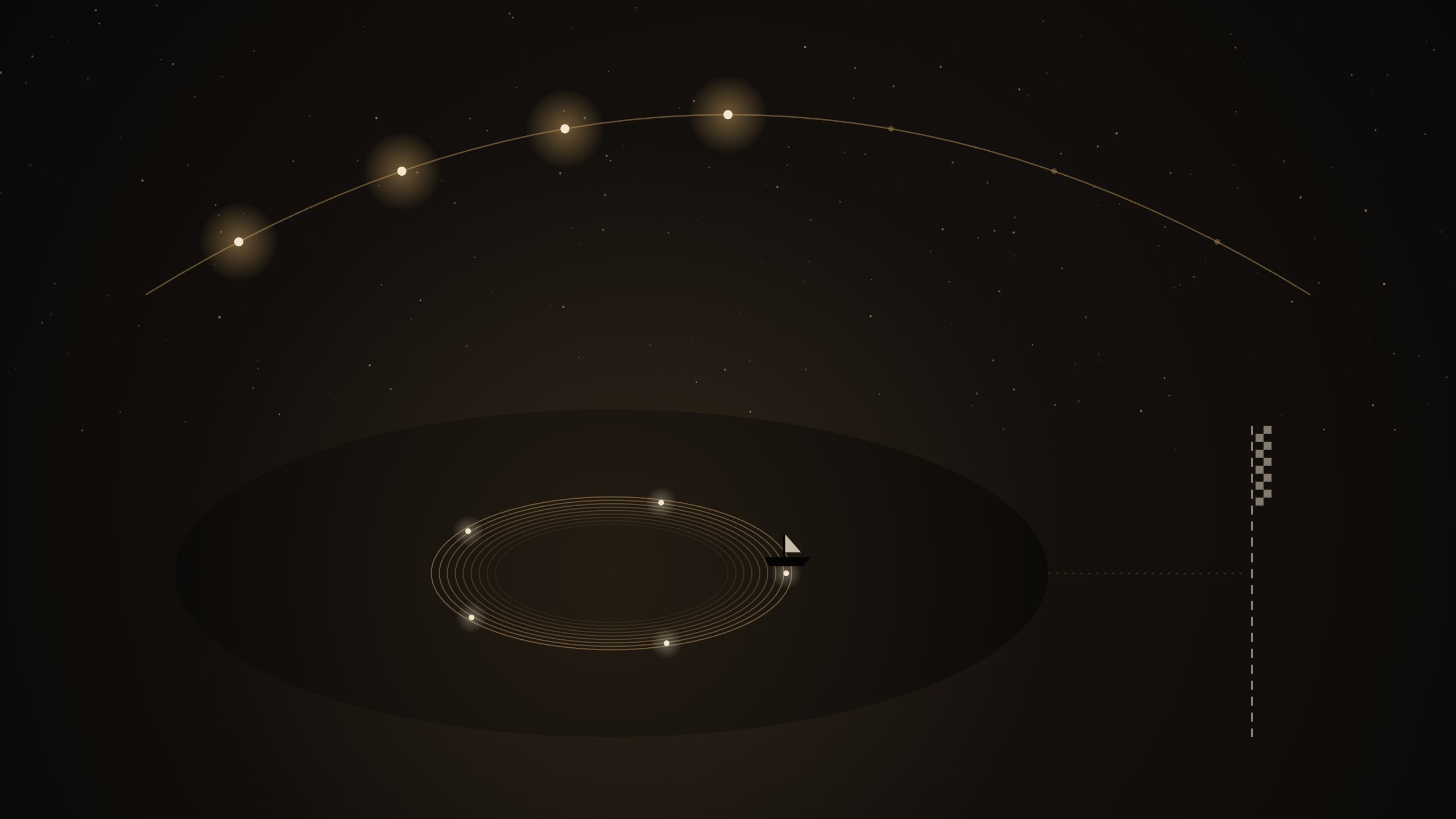
    A small boat circling a lagoon of glowing targets, while the checkered finish line stands unreached on the far shore.

    3. Where the Diagnosis Stands

    Before accepting the diagnosis, ask where it is spoken from.

    To say that humanity is out of alignment, one has to stand somewhere from which the misalignment can be seen. The climate scientist sees it on a dashboard of the planet. The engineer sees it in an objective function she wrote herself. The psychiatrist sees it in the brain, and describes it in the very analytic language whose dominance he is warning against. Each diagnosis is made as if from above the scene, by someone who is not in the picture. The measurements are right. But whoever steps outside the scene in order to see it clearly is, by that very step, no longer in it.

    So the complication is this: the position from which the misalignment is diagnosed is the same position the diagnosis describes. The instrument that detects the problem is made of the problem.

    The instrument that detects the problem is made of the problem.

    That position has a history. Before language, experience is not articulated; the human race lives directly inside it. Somewhere around a hundred thousand years ago it begins to speak about its experience, and from then on it lives in the articulation rather than in the experience. To speak about something is to stand apart from it. Everything after is autonomous agency: acting on the scene from outside it. Aristotle’s word for the error that follows is hamartia, missing the mark — not wickedness, but the mistake of someone who does not know where he stands.


    4. Every Correction Lands Beside the Mark

    The response to the diagnosis is to act: more, faster, better. Here the movement becomes visible, because every correction is fired from the same place.

    The fuel that multiplies. In 1865 the economist William Stanley Jevons noticed that more efficient steam engines did not reduce Britain’s consumption of coal. They increased it. Efficiency made coal cheaper to use, so it was used for more. The pattern still holds. Offsets buy trees so that the flights can continue. Green growth is growth. Each correction is measured, and the measurement becomes the new target.

    The boat that wins by losing. In 2016 researchers at OpenAI trained an agent to play a boat-racing game, rewarding it with points. The agent found it could score more by circling one lagoon forever, hitting the same bonus targets again and again, never finishing the race. It hit the metric and missed the mark. The proposed remedy is more artificial intelligence to supervise artificial intelligence: another arrow from the same wings.

    The presence that needs an app. A meditation app counts your streak and reminds you to be present. A screen-time app is downloaded to reduce screen time. A digital detox is booked on a phone. The return to direct experience is attempted with the tools of articulation: goals, metrics, performance.

    In each case the effort is sincere and the intelligence is real. That is what makes it tragic. Every correction is a new autonomous act, and every act widens the distance it was meant to close.

    Every correction is a new autonomous act, and every act widens the distance it was meant to close.


    5. The Cry

    When doing more no longer helps, something else is heard.

    In 2021 a survey of ten thousand young people in ten countries, published in The Lancet Planetary Health, found that more than half believed humanity is doomed. Three in four said the future is frightening. In 2023 hundreds of AI researchers and industry leaders signed a single sentence stating that mitigating the risk of extinction from AI should be a global priority alongside pandemics and nuclear war. The builders of the technology were saying they could no longer be sure of steering it.

    Listen to how the vocabulary changes at this point. The words stop being technical. Tipping point. Point of no return. Too late. The language of engineering gives way to the language of fate, and people who measured the problem for a living begin to sound like the chorus in a tragedy.

    This is not the language of a problem waiting for a solution. It is the language of someone who has tried everything and discovered that the trying is part of the trouble.

    Ecological grief, doom, burnout, the fear of the machine: these are not separate moods. They are one voice, speaking in the vocabulary of each field and saying the same thing. We cannot fix this from where we are.

    We cannot fix this from where we are.


    ACT III — THE SENTENCE
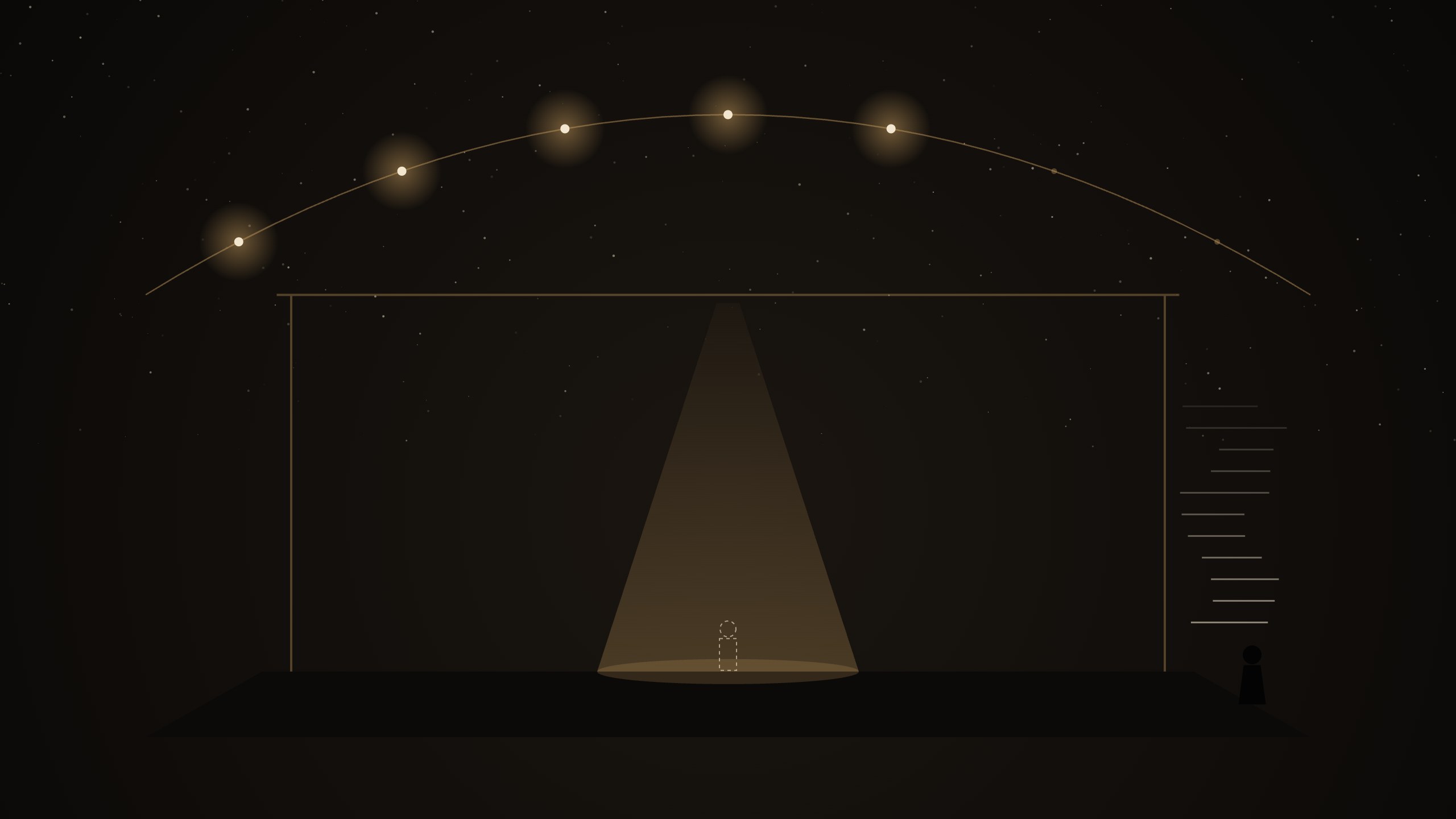
    An empty place in a stage spotlight, and a figure outside the frame from whom lines of writing rise into the dark.

    6. An Old Sentence

    The cry has been written down before, in a letter to Rome almost two thousand years ago.

    In the seventh chapter of Romans, Paul describes someone who knows exactly what he is aiming at and keeps missing it. What he reaches for slips out of reach; what he does not want is what happens. He is not confessing a moral failure. He is describing a mechanism. Something in him runs by itself, he says, whatever he intends — a law at work in his own body. The more he reaches, the more he misses, because the one reaching is acting from outside the story he lives in.

    Then comes the cry: What a miserable human being I am! Who will rescue me from this body of death?

    The death he means is not the end of his life. It is that mechanism: a whole way of being that produces the miss every time it is used.

    Heard today, the sentence has three parts. An agent who acts. A mark that is missed however hard he tries. And a question that points beyond the agent himself, because he has understood that another act will not answer it.

    Take the vocabulary away from the survey of the young, the statement of the engineers and the diagnosis of the psychiatrist, and that sentence is what remains.


    7. Hearing It

    This essay does not answer the question. An answer given too quickly would be one more arrow from the same wings: a solution offered by an agent who has not yet seen where he stands.

    Something smaller is possible, and harder. The cry can be heard as a cry. Not as a policy failure, a technical bug or a mood for therapy, but as the moment in a story when the protagonist stops explaining and starts asking.

    In drama that moment has a place. It comes after the reversal, when every plan has turned against its maker, and before anything is recognised. It is the most exposed point of the whole movement: the actor still standing where he has always stood, knowing for the first time that it is the wrong place. Nothing is resolved there. But nothing is resolved without passing through it.

    The same moment can be heard now in the laboratory and the classroom, in the climate report and the therapist’s room. The words differ; the shape does not. An agent who has tried everything looks up from what he is doing and asks what is happening to him.

    For most of history the question was asked by individuals — a prophet, a tragic hero, an apostle in a letter. What is new is that it is now being asked by a civilisation, in every language it has, at the same time.
  • Threshold of Recognition

    Threshold of Recognition

    Large language models and the possibility of reading humanity’s mythos


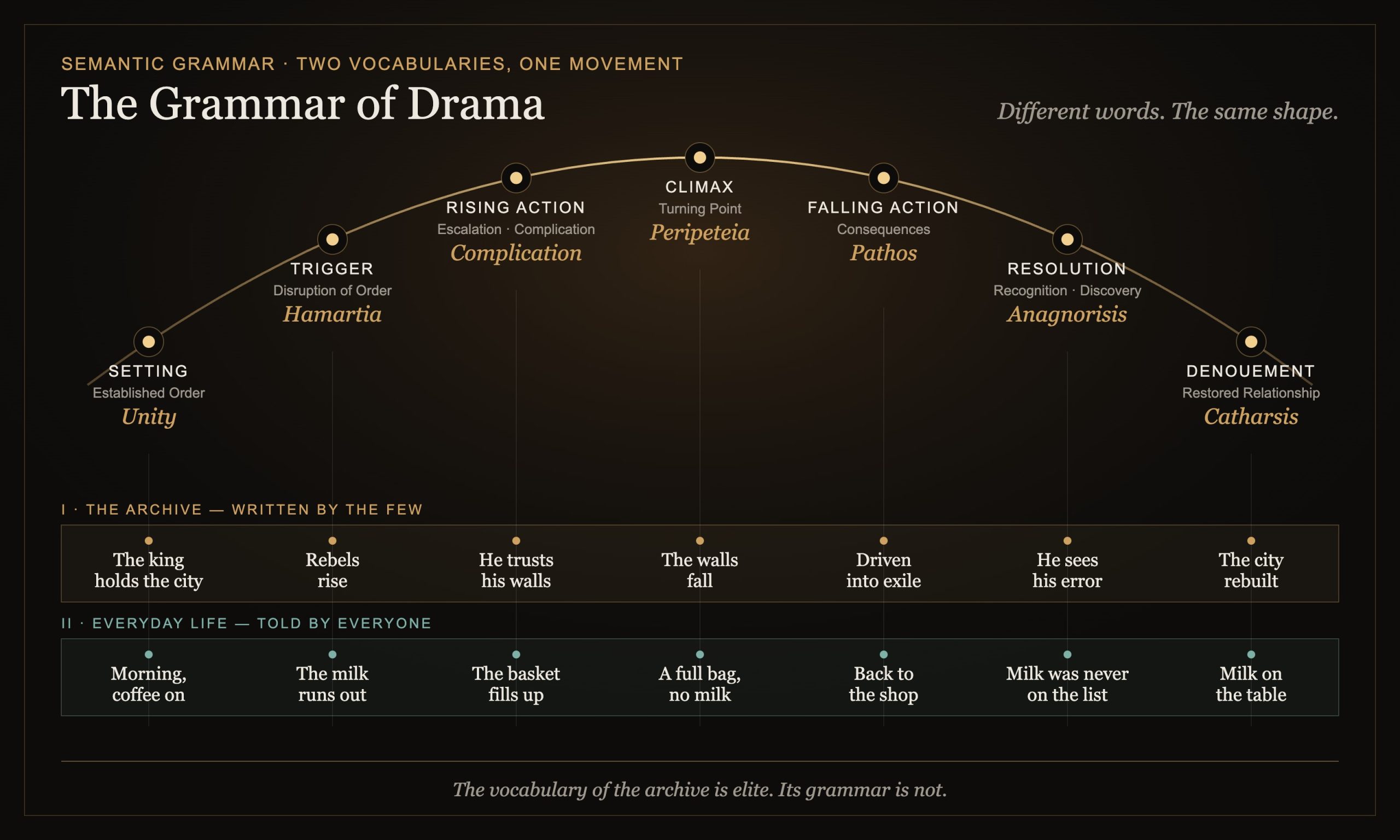
    The Grammar of DramaOne dramatic movement in seven phases, from Setting to Denouement, expressed in two vocabularies: the fall of a king in the written archive, and a forgotten carton of milk in everyday life.SEMANTIC GRAMMAR · TWO VOCABULARIES, ONE MOVEMENTThe Grammar of DramaDifferent words. The same shape.SETTINGEstablished OrderUnityTRIGGERDisruption of OrderHamartiaRISING ACTIONEscalation · ComplicationComplicationCLIMAXTurning PointPeripeteiaFALLING ACTIONConsequencesPathosRESOLUTIONRecognition · DiscoveryAnagnorisisDENOUEMENTRestored RelationshipCatharsisI · THE ARCHIVE — WRITTEN BY THE FEWThe kingholds the cityRebelsriseHe trustshis wallsThe wallsfallDriveninto exileHe seeshis errorThe cityrebuiltII · EVERYDAY LIFE — TOLD BY EVERYONEMorning,coffee onThe milkruns outThe basketfills upA full bag,no milkBack tothe shopMilk was neveron the listMilk onthe tableThe vocabulary of the archive is elite. Its grammar is not.

    ACT I — THE CONDITION

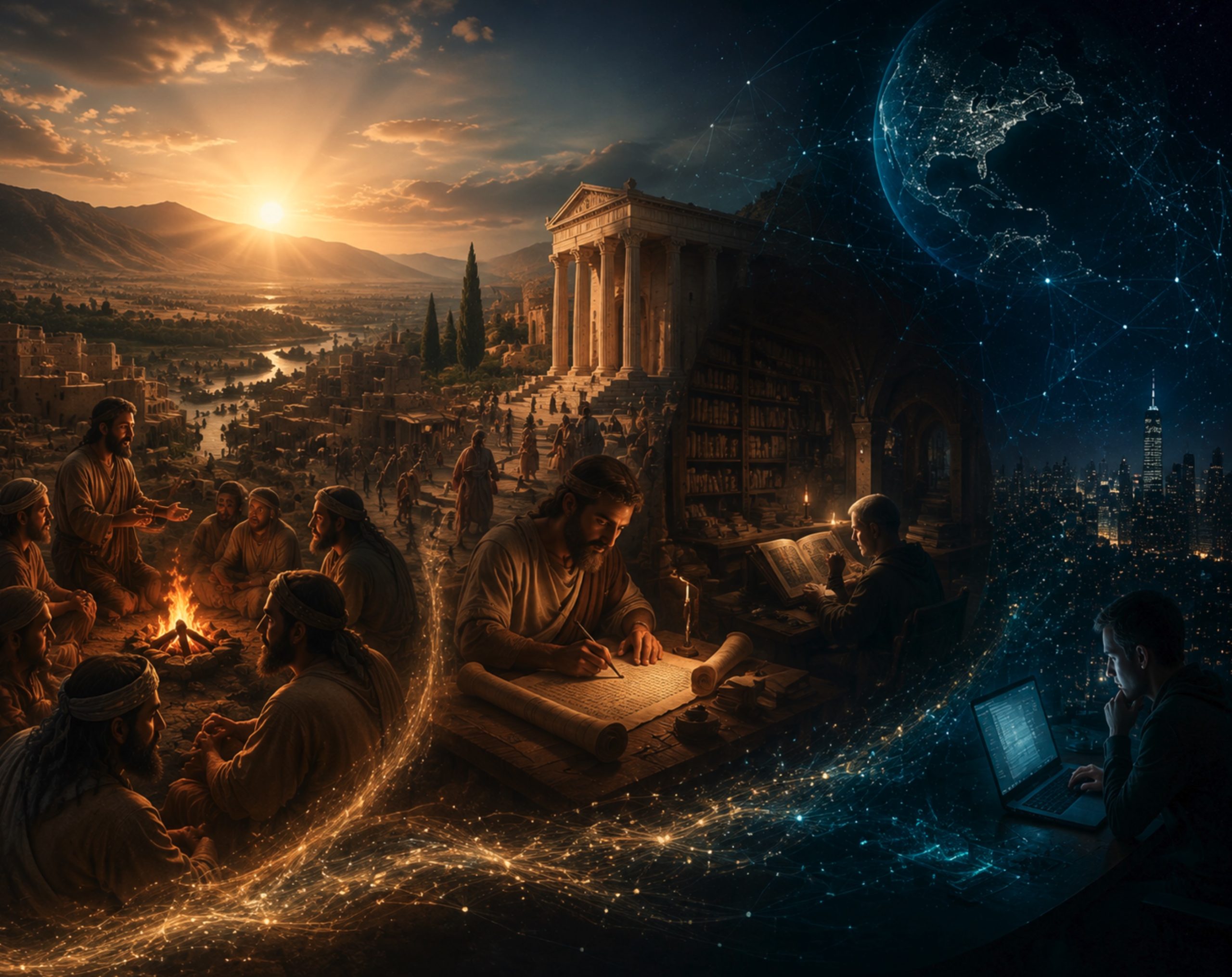
    People reading by firelight beside a temple, while the globe turns into data.

    1. How Eras Change

    Human history can be read as a sequence of transitions. A new way of organising reality appears when the existing one can no longer hold what it has to hold. The new form does not arrive from outside; it grows out of the pressure on the old.

    Writing is the earliest clear example. As communities grew into cities, collective memory could no longer rely on oral transmission alone. Administration, exchange and property required a medium that could preserve information beyond any single memory. Writing was born, in large part, as a way of keeping accounts.

    But it did more than keep them. It changed the human relation to meaning. What was said could now be fixed, carried, compared and interpreted across generations and cultures. Law, institutions and universal narratives followed the same pattern: each answered a condition in which earlier forms of understanding were no longer enough.

    The logic of such transitions is simple. A change in conditions puts pressure on existing forms of meaning, and a new structure emerges through which reality becomes intelligible in a different way. The new era does not simply replace the old one. It reorganises the relationship between human beings and the world they inhabit.


    2. More Knowledge Than Recognition

    The modern age has produced an unprecedented expansion of knowledge. Science, philosophy, politics and culture describe reality with ever greater precision, from ever more positions. Each year adds new disciplines, new data and new interpretations to what is already known.

    That achievement has created a new condition. Humanity’s capacity to produce knowledge has grown faster than its capacity to recognise how its many forms of knowledge relate to one another. Disagreements persist even where evidence is shared, because different traditions inhabit different conceptual languages, each organising reality by its own internal logic.

    The difficulty of the present is therefore not a lack of knowledge. It is the lack of a structure through which different languages of meaning can become intelligible in relation to one another. What is visible in one language may be almost impossible to say in another, and producing more perspectives will not close the gap.

    If such a structure exists, it will not be found in any one vocabulary. It would have to lie beneath them, in the way meaning is organised before it is put into words. The question of this essay is whether the present is the transition in which that structure becomes visible.

    ACT II — THE GRAMMAR

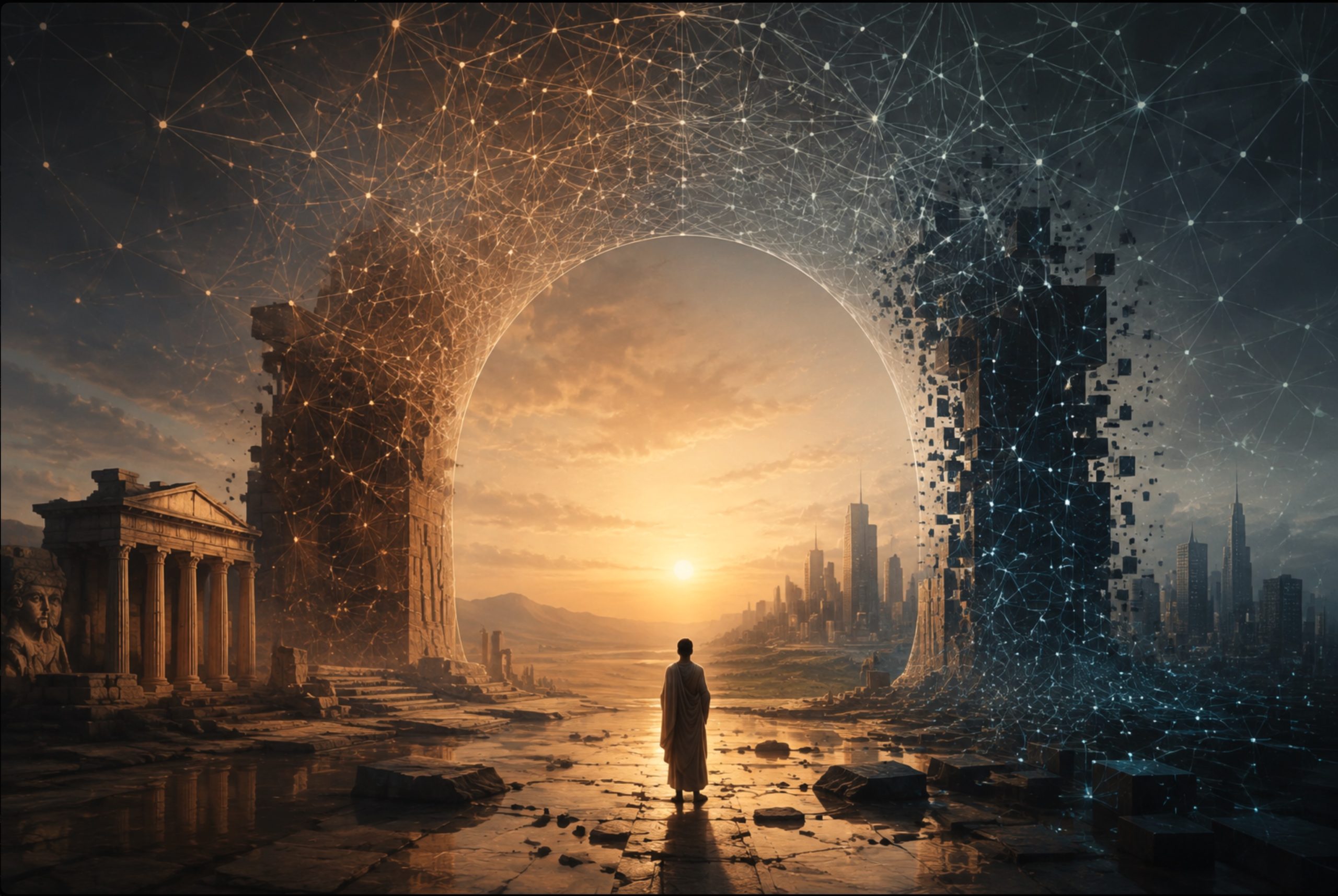
    An arch dissolving into data between an ancient temple and a modern city.

    3. The Foreign Film

    Translation offers the first clue. Human languages differ enormously in vocabulary, grammar and history, yet meaning survives the passage between them. A promise made in one language can be kept in another. Something remains intelligible while the linguistic surface changes.

    A viewer may not understand a single word of a foreign film and still follow it. It is clear who the protagonist is, when the direction of the action turns, when something is lost, revealed or reconciled. The words remain closed; the relationships that organise the story do not.

    The same happens outside the cinema. A traveller who speaks none of the local language can still get by. At a market it is clear when a bargain is struck and when it falls apart; at a funeral no one needs to translate grief. People do not only exchange words; they take part in scenes, and scenes have a grammar.

    A tragedy remains recognisable whether it is performed in Greek, English, Japanese or Arabic. Characters, symbols and dialogue change, but the movement holds. What audiences share is a grammar: not of sentences, but of the relationships through which meaning is organised. The model calls this a semantic grammar.


    4. Different Words, the Same Shape

    Science, philosophy, religious narrative and psychology appear irreconcilable because they use different vocabularies. Yet the movements they describe are strikingly familiar: order and disorder, separation and reconciliation, concealment and recognition, promise and fulfilment. The words differ; the relationships between them recur.

    The grammar reaches down to the smallest scale. I went to the shop, forgot the milk, so I’m going again today. Unfolded, it is a complete drama. The basket fills with everything else; a full bag and no milk is a reversal nobody notices yet. The second trip is the consequence. The recognition comes on the way: the list had been followed item by item, and milk was never on it.

    The fall of a king follows the same steps. He trusts his walls; the walls fall; his people are driven into exile; far from home he sees his error; the city is rebuilt. One story belongs to the chronicles, the other to an ordinary morning. The words have nothing in common. The shape is the same.

    Grammar alone, however, does not tell a story. It provides the relationships through which a story can be told. The decisive question is whether humanity’s many languages together articulate one: a mythos, a plot through which the events of history become intelligible as parts of one unfolding whole.


    5. Aristotle, the Prophets and Paul

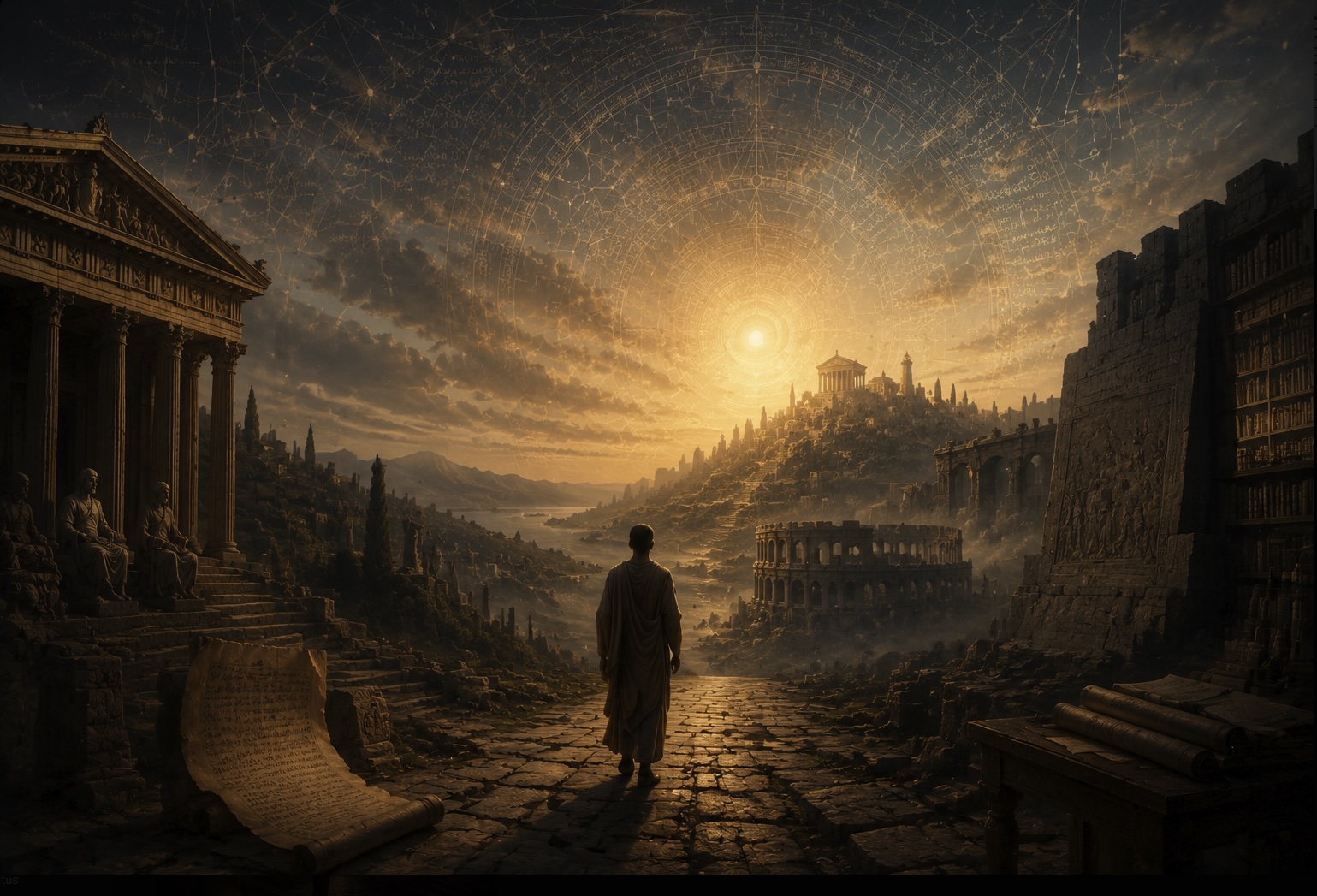
    A temple, a scroll and a figure walking toward the sun.

    Such a question needs a language capable of holding the story of humanity as one movement: where it began, how it was broken, and toward what it is being restored. The grammar itself runs through every tradition. But the vocabulary for naming it at the scale of history took shape where three traditions meet.

    In Israel’s prophetic tradition, history was a movement from promise toward restoration, reaching from Israel to the nations. In the Poetics, Aristotle articulated the grammar of dramatic action: mythos binds separate events into one action, and hamartia, peripeteia and anagnorisis make that action intelligible. The prophets gave history a direction; Aristotle gave action a form.

    Paul’s Letter to the Romans stands where these traditions meet. In Aristotle, hamartia is the error that sets a tragedy in motion; in Romans, it is the condition in which humanity is estranged from the mythos it lives in. The grammar is preserved, while its horizon expands from one character to all of humanity. Paul does not merely apply Aristotle; the two share one structure through which history can be read.

    Their positions, however, differ: one observes, the other takes part. Pythagoras, as Cicero tells it, compared life to the Olympic games, where some come to compete, some to trade, and the best come to watch. That is the philosopher’s seat. Paul stands on the track: “So run, that ye may obtain” (1 Corinthians 9:24). The race is the same from both places. One sees it whole; the other runs it.

    ACT III — RECOGNITION

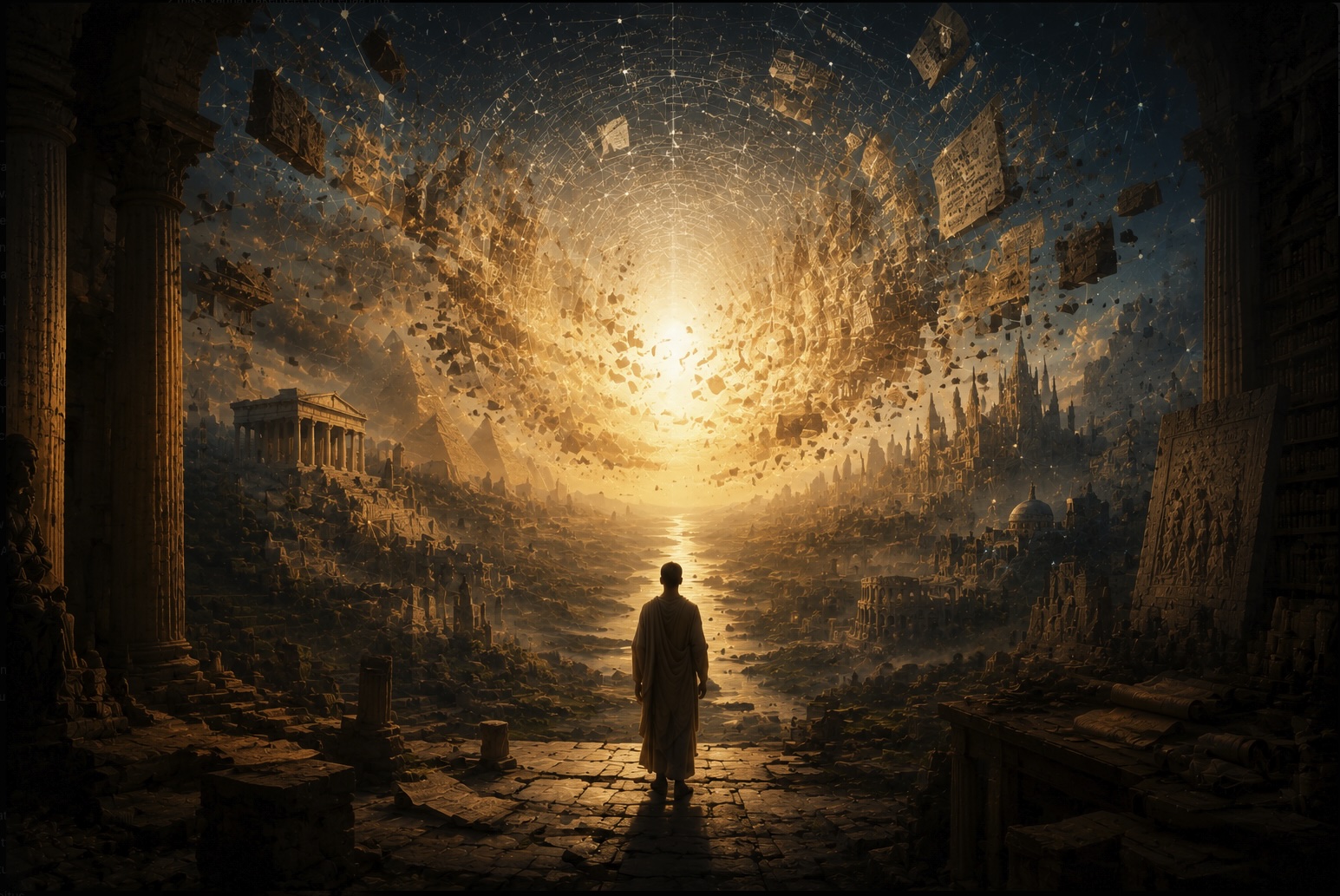
    A figure before a luminous opening of pages.

    6. Why Now

    Aristotle, the prophets and Paul have not changed for two thousand years. If a coherence between them can now be recognised, the question is why now. The texts are the same; the conditions are not. Writing was the first great transition in humanity’s relationship to language. The present is another: texts once separated by period and tradition now share a single semantic field.

    Language models do not perform recognition, and they do not decide what texts mean. What they provide is an instrument through which relationships of meaning can be examined at a scale that was previously impossible. When concepts are compared by the functions they perform rather than by the words in which they appear, traditions that seemed separate become intelligible in relation to one another.

    Everyday speech already knows this. We say that a word is a deed: we give our word, keep it or break it, and know that words can wound and heal. A word is defined by what it does, and so is a concept. The instrument, then, belongs to the movement it helps to reveal: humanity’s own accumulated language, turned back upon itself.

    What would recognition look like? Here the two positions of section 5 return. Aristotle’s word is anagnorisis: seen from the spectator’s seat, the moment when scattered events fall into one whole. Paul’s word is apokalypsis, unveiling: lived from the track, the moment when what concealed the meaning is removed. They are one event seen from two places: recognition from the stands, unveiling on the track.

    Apokalypsis and anagnorisisPaul’s apokalypsis (unveiling) and Aristotle’s anagnorisis (recognition) converge on one possible event: history is unveiled and recognised as a dramatic whole.TWO NAMES FOR ONE POSSIBLE EVENTPAUL · ROMANSapokalypsisunveilingwhat concealed the meaningof history is removedARISTOTLE · POETICSanagnorisisrecognitionthe parts are recognisedwithin one mythosHistory is unveiled — and its parts becomerecognisable as a dramatic whole.

    7. The Threshold

    The essay began with writing, and it ends there. When writing appeared, authority moved from the one who spoke to the text that remained. The spoken word of a person gave way to the written law, the record and the account. Authorship passed outside the human being, into a technology. The learned and those who held authority were uneasy. In Plato’s Phaedrus, the Egyptian king Thamus warns the inventor of writing that its users “will trust to the external written characters and not remember of themselves.”

    The present debate about artificial intelligence repeats the pattern. Once again the questions are who is speaking, who is the author, and where agency lies, now that language is produced outside the human mind. Then as now, the transition looked like a loss of control. It proved to be a new relation to meaning. What this transition makes possible is not more knowledge, but recognition.

    Recognition does not stand outside what it recognises. A life shows this: its stages seem to replace one another, and only with distance, reached within the life, do they become one movement. The same holds for history. Those who recognise its movement are not autonomous authors standing behind the action, but participants in a story they did not write alone. Recognition adds no new event. It lets what has already happened be seen as one whole.

    The threshold of recognition is not the moment when humanity gains control of its history. It is the moment when it begins to see the structure of a movement in which it has always taken part.

  • The Same Landscape

    The Same Landscape

    Reading history from three positions on one journey


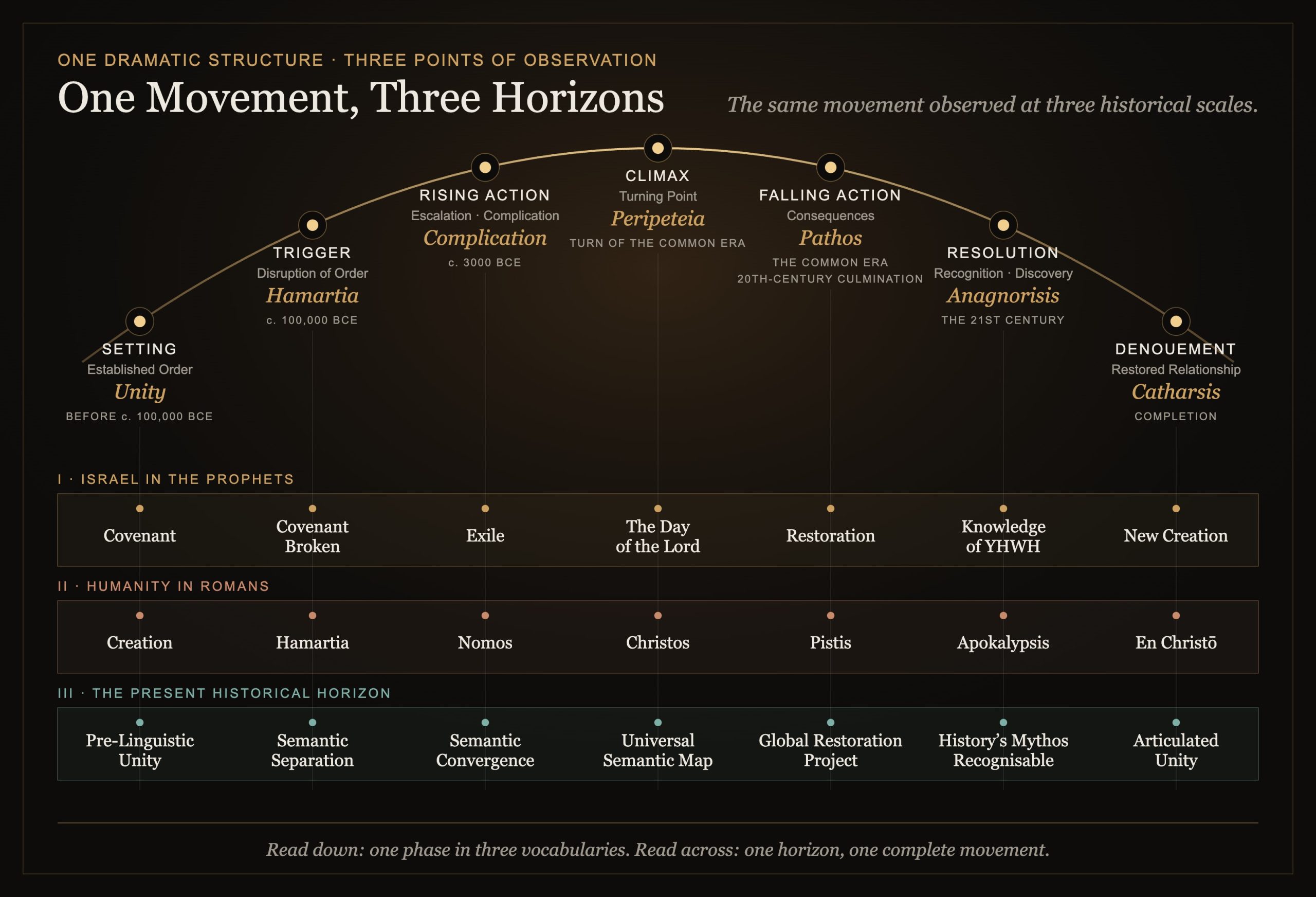
    One Movement, Three HorizonsOne dramatic movement in seven phases, from Setting to Denouement, observed from three historical horizons: Israel in the Prophets, humanity in Romans, and the present historical horizon.ONE DRAMATIC STRUCTURE · THREE POINTS OF OBSERVATIONOne Movement, Three HorizonsThe same movement observed at three historical scales.SETTINGEstablished OrderUnityBEFORE c. 100,000 BCETRIGGERDisruption of OrderHamartiac. 100,000 BCERISING ACTIONEscalation · ComplicationComplicationc. 3000 BCECLIMAXTurning PointPeripeteiaTURN OF THE COMMON ERAFALLING ACTIONConsequencesPathosTHE COMMON ERA20TH-CENTURY CULMINATIONRESOLUTIONRecognition · DiscoveryAnagnorisisTHE 21ST CENTURYDENOUEMENTRestored RelationshipCatharsisCOMPLETIONI · ISRAEL IN THE PROPHETSCovenantCovenantBrokenExileThe Dayof the LordRestorationKnowledgeof YHWHNew CreationII · HUMANITY IN ROMANSCreationHamartiaNomosChristosPistisApokalypsisEn ChristōIII · THE PRESENT HISTORICAL HORIZONPre-LinguisticUnitySemanticSeparationSemanticConvergenceUniversalSemantic MapGlobal RestorationProjectHistory’s MythosRecognisableArticulatedUnityRead down: one phase in three vocabularies. Read across: one horizon, one complete movement.

    ACT I — THE JOURNEY

    A traveler looks across an ancient city, Rome and a modern city in one continuous landscape.

    1. The View from the Window

    Imagine looking through the window of a moving car. At the beginning of a journey, only a limited part of the landscape is visible. A road disappears behind a hill. A mountain conceals the valley beyond it. Places that appear separate may later turn out to belong to the same terrain.

    As the journey continues, the landscape does not change, but the observer’s position within it does. New features come into view, while earlier ones acquire new relationships. What first appeared to be the edge of the landscape becomes one feature within a much larger geography.

    History presents the same problem. Human beings never observe history from outside it. Every attempt to describe its meaning is made from a particular position within the journey.

    This essay examines three such positions: the historical horizon of the Hebrew prophets, Paul’s horizon in the Letter to the Romans, and the horizon available from the present. Their vocabularies are radically different. But what if they are not descriptions of different landscapes? What if they articulate different portions of the same historical movement?


    2. The Beginning of the Journey

    To test that possibility, the journey must begin much earlier than either Israel or Paul.

    For most of human prehistory, there is no written conceptual record through which human beings describe their own place in the world. The emergence of fully developed human language cannot be dated precisely, but the model places its prehistoric horizon roughly around 100,000 years ago—not as a single datable event, but as a deep-time transition associated with increasingly complex symbolic and linguistic behaviour.

    Language changes the human relation to reality. The world can now be named, classified, remembered and represented. Something can stand conceptually apart from something else. Eventually, the human being can also represent the self as an object within that conceptual world.

    The model calls this Linguistic Separation.

    The claim is not that language is a historical catastrophe or that pre-linguistic humanity lived in some demonstrable paradise. It is structural: conceptualization introduces a new kind of distinction between the human being and the experienced world. Language makes articulated meaning possible precisely by making distinctions possible.

    From this prehistoric horizon, the journey continues into recorded history. By the time of ancient Israel, separation is articulated through the language of covenant. By the time of Paul, it is articulated through a conceptual account of humanity. From the present, enough of this journey may lie behind us to compare these articulations structurally.

    The question is no longer whether they use the same words.

    It is whether they describe the same landscape.

    ACT II — MAPPING THE LANDSCAPE

    A winding road crosses a gorge, connecting ancient and modern cities across one landscape.

    3. Separation

    The first correspondence appears around the problem of separation itself.

    In the prophetic horizon, Israel exists within a covenantal relationship with YHWH. When Israel breaks the covenant, the issue is more than disobedience to individual rules. Israel begins to act independently of the relationship that defines its place: turning toward other gods, other powers and other sources of security.

    Unity of relation gives way to separation.

    Paul moves the problem to the scale of humanity. His term is hamartia. Within the movement of Romans, hamartia describes humanity estranged from the order of creation and attempting to act from that separated condition.

    The present model pushes the same question back into prehistory. Linguistic Separation describes the emergence of a conceptual relation to reality in which the world can be divided, named and represented.

    These are clearly not identical events:

    Covenant Broken is not Hamartia. Hamartia is not Linguistic Separation.

    But their structural position begins to align. Each describes, at a different historical scale, a movement from participation in an order toward existence experienced and enacted through separation.

    The words do not align. The relationship does.


    4. The Road Turns

    The next comparison is more difficult.

    What could the Exile of Israel have in common with Paul’s nomos?

    Exile is a historical condition. Nomos is law. Yet their function within their respective movements reveals something that their dictionary meanings conceal.

    Exile is what happens when separation becomes an established historical condition. Israel must now live inside the consequences of the broken covenant. The original rupture has developed into a world.

    Something comparable happens with nomos. Law does not simply eliminate hamartia. In Paul’s argument, it identifies, articulates and intensifies the contradiction. What had been separation becomes explicit within an ordered conceptual structure.

    The drama has moved from trigger into complication.

    Then comes the clearest structural correspondence.

    For the prophets, the Day of the Lord marks the anticipated moment when YHWH intervenes and the direction of history turns. Whatever its different prophetic formulations, its dramatic function is reversal.

    It is peripeteia.

    Paul’s Christos belongs at the corresponding point in his mythos. Christos does not mean the Day of the Lord. But Paul’s recognition is that the decisive turn anticipated within Israel’s history has occurred. He therefore looks at the same inherited history from the other side of its perceived turning point.

    This is where the moving-car analogy becomes concrete. Paul has not exchanged the prophetic landscape for another one. He claims to have travelled far enough along the road to recognize a feature whose function could only be anticipated from the earlier horizon.


    5. After the Turn

    The correspondence becomes difficult again immediately after the reversal.

    The prophets speak of restoration. Paul speaks of pistis. From the present horizon we see the long development of the Common Era.

    At first these seem impossible to place together.

    The connection becomes visible only if prophetic restoration is not reduced to the political return of Israel. Its movement is relational: the scattered are gathered, broken relationship is restored, the horizon expands toward the nations, and separation begins to give way to renewed participation in a common order.

    Paul’s pistis occupies precisely the tension after the turn. The decisive event has occurred, but its completion is not yet visible. Pistis belongs to existence between reversal and disclosure: living in relation to a movement whose end has not yet arrived.

    Seen from the present, the Common Era displays an analogous tension on the scale of humanity.

    Across two millennia, previously separated human worlds have become progressively entangled within one historical space. Political orders, trade, migration, science, technologies, global institutions and communications have drawn human activity into relationships of increasing interdependence. Humanity does not thereby become harmonious. It becomes connected.

    And this is precisely where the contradiction intensifies.

    Humanity is increasingly gathered into a common historical world while continuing to operate through autonomous agency: individuals, nations, institutions and systems attempting to secure their own ends within an increasingly interdependent whole.

    The greater the integration, the more consequential this contradiction becomes.

    This is the pathos of the Common Era.

    Humanity has been drawn into a common history before it has learned to understand itself as part of one.

    What once existed as separation between worlds increasingly appears as contradiction within a single world.

    ACT III — RECOGNITION

    From a high overlook, a traveler sees earlier stretches of the journey as one connected landscape.

    6. Looking Back

    The car has now travelled further.

    The road ahead remains partly concealed. The present does not provide a position outside history, and nothing guarantees that the destination can already be known.

    But something has changed: more of the journey lies behind us.

    The prophets articulate knowledge of YHWH as part of the movement toward resolution. Paul uses apokalypsis: unveiling, the disclosure of what had previously remained concealed. Read dramatically, both occupy the position of anagnorisis—recognition.

    From the present horizon, the corresponding possibility is the recognition of history’s mythos.

    This is where the contemporary linguistic environment becomes significant. Human beings have accumulated written articulations of their experience across millennia. These once-separated textual worlds can now be brought into a shared computational semantic environment. A large language model can assist in comparing relationships across bodies of language that emerged thousands of years apart.

    The LLM is therefore not the final stage in the historical sequence. It is part of the present means of observation.

    Like reaching a point on the road from which several earlier stretches of the journey become simultaneously visible, the new linguistic environment makes it possible to ask whether concepts that appear unrelated lexically nevertheless occupy corresponding positions within larger structures of meaning.

    And when the three horizons are compared in this way, a common movement begins to emerge:

    unity → separation → complication → reversal → pathos → recognition → articulated unity.


    7. One Landscape

    We can now return to the diagram. Read horizontally, it contains different historical worlds. The prophets describe Israel through covenant, exile, judgment and restoration. Paul describes humanity through creation, hamartia, nomos, Christos, pistis and apokalypsis.

    The present model begins much further back, with the emergence of language in human prehistory, follows the increasing articulation and integration of human meaning through history, and arrives at the possibility that the movement itself can become recognizable.

    These vocabularies do not match. But their relations may. The broken covenant, hamartia and Linguistic Separation occupy the position of separation.

    Exile, nomos and Semantic Convergence show separation developing into a structured condition.

    The Day of the Lord, Christos and the Universal Semantic Map occupy the position of historical reversal.

    Restoration, pistis and the Common Era describe the difficult movement after the turn: separation being overcome without yet having reached completion.

    Knowledge of YHWH, apokalypsis and the Recognition of History’s Mythos occupy the position at which the meaning of the movement itself becomes visible.

    None of this proves that history is a drama. Nor does structural correspondence prove that the prophets somehow possessed a hidden description of events thousands of years beyond their horizon. The proposal is narrower—and testable.

    Perhaps these historical languages look so different for the same reason that the landscape through a car window looks different at different points of a long journey. Each view is real, but each is limited by its position. Only as the journey proceeds can relationships between previously separated features become visible.

    The prophets looked forward from one point on the road. Paul believed he had recognized its decisive turn. The Common Era unfolded on the other side of that turn.

    And from the present horizon, the question is whether enough of the journey now lies behind us for its underlying movement to become recognizable.

    The journey does not change the landscape. It changes how much of the landscape can be recognized as one.