Large language models and the possibility of reading humanity’s mythos
ACT I — THE CONDITION
1. How Eras Change
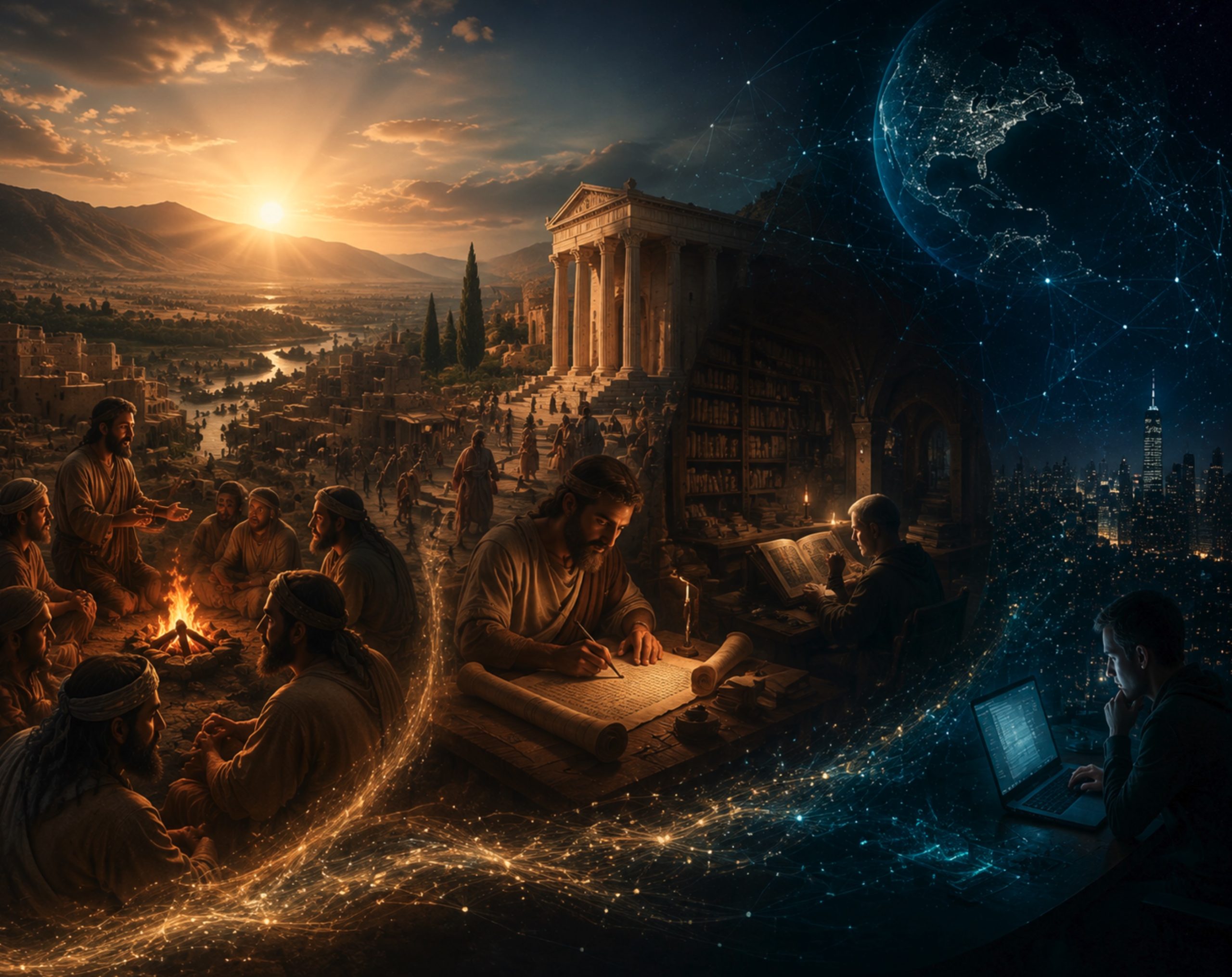
Human history can be read as a sequence of transitions. A new way of organising reality appears when the existing one can no longer hold what it has to hold. The new form does not arrive from outside; it grows out of the pressure on the old.
Writing is the earliest clear example. As communities grew into cities, collective memory could no longer rely on oral transmission alone. Administration, exchange and property required a medium that could preserve information beyond any single memory. Writing was born, in large part, as a way of keeping accounts.
But it did more than keep them. It changed the human relation to meaning. What was said could now be fixed, carried, compared and interpreted across generations and cultures. Law, institutions and universal narratives followed the same pattern: each answered a condition in which earlier forms of understanding were no longer enough.
The logic of such transitions is simple. A change in conditions puts pressure on existing forms of meaning, and a new structure emerges through which reality becomes intelligible in a different way. The new era does not simply replace the old one. It reorganises the relationship between human beings and the world they inhabit.
2. More Knowledge Than Recognition
The modern age has produced an unprecedented expansion of knowledge. Science, philosophy, politics and culture describe reality with ever greater precision, from ever more positions. Each year adds new disciplines, new data and new interpretations to what is already known.
That achievement has created a new condition. Humanity’s capacity to produce knowledge has grown faster than its capacity to recognise how its many forms of knowledge relate to one another. Disagreements persist even where evidence is shared, because different traditions inhabit different conceptual languages, each organising reality by its own internal logic.
The difficulty of the present is therefore not a lack of knowledge. It is the lack of a structure through which different languages of meaning can become intelligible in relation to one another. What is visible in one language may be almost impossible to say in another, and producing more perspectives will not close the gap.
If such a structure exists, it will not be found in any one vocabulary. It would have to lie beneath them, in the way meaning is organised before it is put into words. The question of this essay is whether the present is the transition in which that structure becomes visible.
ACT II — THE GRAMMAR

3. The Foreign Film
Translation offers the first clue. Human languages differ enormously in vocabulary, grammar and history, yet meaning survives the passage between them. A promise made in one language can be kept in another. Something remains intelligible while the linguistic surface changes.
A viewer may not understand a single word of a foreign film and still follow it. It is clear who the protagonist is, when the direction of the action turns, when something is lost, revealed or reconciled. The words remain closed; the relationships that organise the story do not.
The same happens outside the cinema. A traveller who speaks none of the local language can still get by. At a market it is clear when a bargain is struck and when it falls apart; at a funeral no one needs to translate grief. People do not only exchange words; they take part in scenes, and scenes have a grammar.
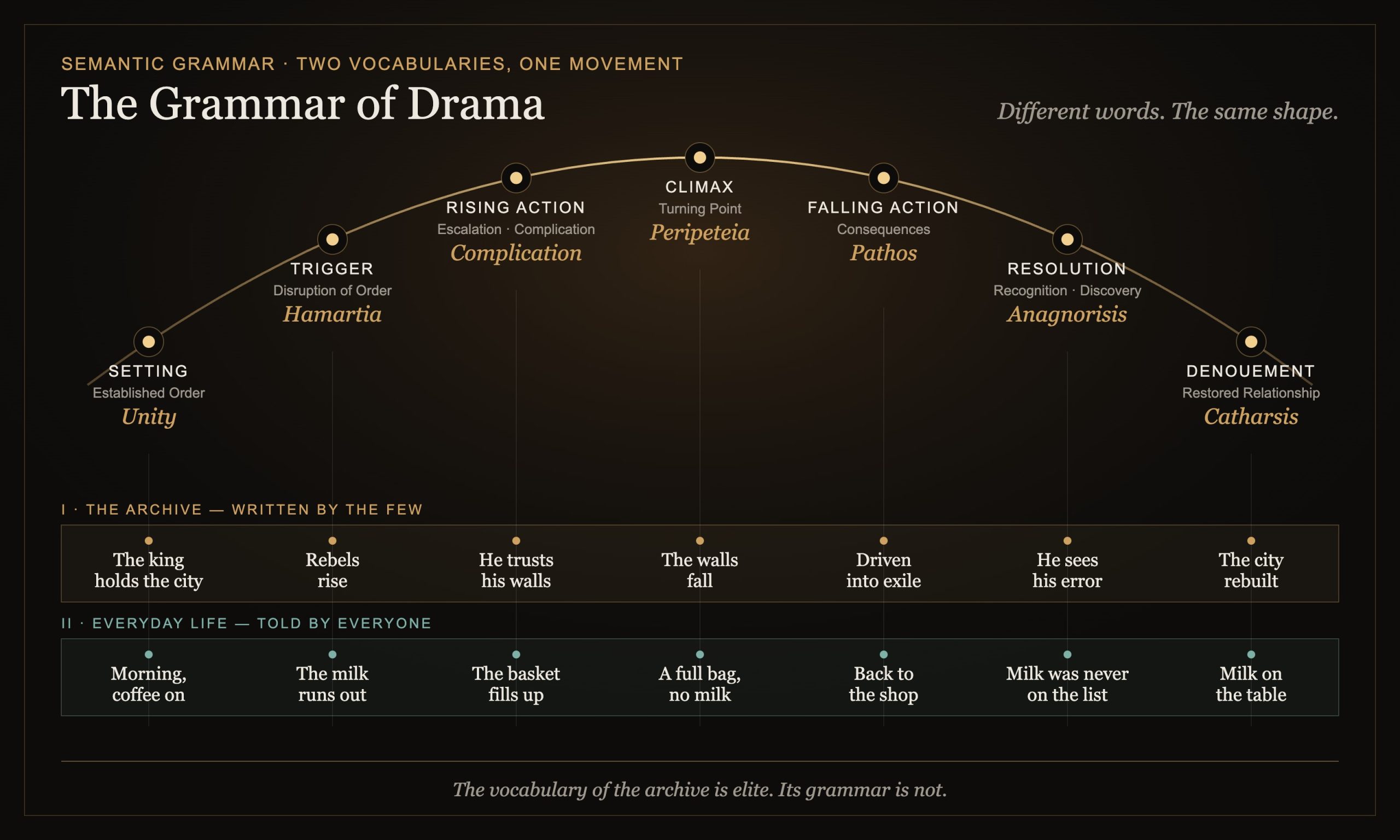
A tragedy remains recognisable whether it is performed in Greek, English, Japanese or Arabic. Characters, symbols and dialogue change, but the movement holds. What audiences share is a grammar: not of sentences, but of the relationships through which meaning is organised. The model calls this a semantic grammar.
4. Different Words, the Same Shape
Science, philosophy, religious narrative and psychology appear irreconcilable because they use different vocabularies. Yet the movements they describe are strikingly familiar: order and disorder, separation and reconciliation, concealment and recognition, promise and fulfilment. The words differ; the relationships between them recur.
The grammar reaches down to the smallest scale. I went to the shop, forgot the milk, so I’m going again today. Unfolded, it is a complete drama. The basket fills with everything else; a full bag and no milk is a reversal nobody notices yet. The second trip is the consequence. The recognition comes on the way: the list had been followed item by item, and milk was never on it.
The fall of a king follows the same steps. He trusts his walls; the walls fall; his people are driven into exile; far from home he sees his error; the city is rebuilt. One story belongs to the chronicles, the other to an ordinary morning. The words have nothing in common. The shape is the same.
Grammar alone, however, does not tell a story. It provides the relationships through which a story can be told. The decisive question is whether humanity’s many languages together articulate one: a mythos, a plot through which the events of history become intelligible as parts of one unfolding whole.
5. Aristotle, the Prophets and Paul
Such a question needs a language capable of holding the story of humanity as one movement: where it began, how it was broken, and toward what it is being restored. The grammar itself runs through every tradition. But the vocabulary for naming it at the scale of history took shape where three traditions meet.
In Israel’s prophetic tradition, history was a movement from promise toward restoration, reaching from Israel to the nations. In the Poetics, Aristotle articulated the grammar of dramatic action: mythos binds separate events into one action, and hamartia, peripeteia and anagnorisis make that action intelligible. The prophets gave history a direction; Aristotle gave action a form.
Paul’s Letter to the Romans stands where these traditions meet. In Aristotle, hamartia is the error that sets a tragedy in motion; in Romans, it is the condition in which humanity is estranged from the mythos it lives in. The grammar is preserved, while its horizon expands from one character to all of humanity. Paul does not merely apply Aristotle; the two share one structure through which history can be read.
Their positions, however, differ: one observes, the other takes part. Pythagoras, as Cicero tells it, compared life to the Olympic games, where some come to compete, some to trade, and the best come to watch. That is the philosopher’s seat. Paul stands on the track: “So run, that ye may obtain” (1 Corinthians 9:24). The race is the same from both places. One sees it whole; the other runs it.
ACT III — RECOGNITION
6. Why Now
Aristotle, the prophets and Paul have not changed for two thousand years. If a coherence between them can now be recognised, the question is why now. The texts are the same; the conditions are not. Writing was the first great transition in humanity’s relationship to language. The present is another: texts once separated by period and tradition now share a single semantic field.
Language models do not perform recognition, and they do not decide what texts mean. What they provide is an instrument through which relationships of meaning can be examined at a scale that was previously impossible. When concepts are compared by the functions they perform rather than by the words in which they appear, traditions that seemed separate become intelligible in relation to one another.
Everyday speech already knows this. We say that a word is a deed: we give our word, keep it or break it, and know that words can wound and heal. A word is defined by what it does, and so is a concept. The instrument, then, belongs to the movement it helps to reveal: humanity’s own accumulated language, turned back upon itself.
What would recognition look like? Here the two positions of section 5 return. Aristotle’s word is anagnorisis: seen from the spectator’s seat, the moment when scattered events fall into one whole. Paul’s word is apokalypsis, unveiling: lived from the track, the moment when what concealed the meaning is removed. They are one event seen from two places: recognition from the stands, unveiling on the track.
7. The Threshold
The essay began with writing, and it ends there. When writing appeared, authority moved from the one who spoke to the text that remained. The spoken word of a person gave way to the written law, the record and the account. Authorship passed outside the human being, into a technology. The learned and those who held authority were uneasy. In Plato’s Phaedrus, the Egyptian king Thamus warns the inventor of writing that its users “will trust to the external written characters and not remember of themselves.”
The present debate about artificial intelligence repeats the pattern. Once again the questions are who is speaking, who is the author, and where agency lies, now that language is produced outside the human mind. Then as now, the transition looked like a loss of control. It proved to be a new relation to meaning. What this transition makes possible is not more knowledge, but recognition.
Recognition does not stand outside what it recognises. A life shows this: its stages seem to replace one another, and only with distance, reached within the life, do they become one movement. The same holds for history. Those who recognise its movement are not autonomous authors standing behind the action, but participants in a story they did not write alone. Recognition adds no new event. It lets what has already happened be seen as one whole.
The threshold of recognition is not the moment when humanity gains control of its history. It is the moment when it begins to see the structure of a movement in which it has always taken part.